Operations Overview
Seekers Spirits is a craft distillery in Phnom Penh, Cambodia. At the time of this incident, production ran on two stills: a 300L legacy still and a 2000L still installed in early 2023. The 300L still had a stable, established operating pattern. The 2000L still handled larger runs, but its cooling system depended on a reservoir originally sized for the smaller equipment. I owned quality control end-to-end, from tasting through to final release decisions.
Still Configuration
The 2000L still used a main condenser and pre-cooler connected to a shared coolant reservoir. That reservoir had originally been designed for the smaller 300L still and was reused without modification. In Cambodia, ambient temperatures typically range from 28 to 35°C, which reduced cooling efficiency. During longer runs, heat entered the system faster than it could be removed.
This created a gradual rise in coolant temperature during long runs, with no mechanism to detect or record it.
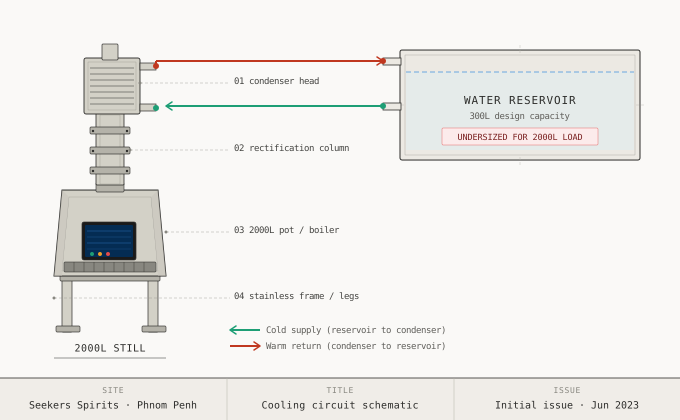
Cooling circuit schematic. The reservoir was designed for the 300L still and reused without modification on the 2000L still.
Observability Gaps
Two observability gaps defined both the failure and the investigation.
Together, these gaps meant there was no production-time record to analyse. The failure could not be observed as it developed and had to be reconstructed after the fact.
In practice, detection depended on someone checking the system during the run. During Batch 50, that did not happen.